|
KAFS News
Roman Villa Barn Faversham Abbey 2023
Excavation of a Roman Aisled Barn and Bath-house at Faversham in Kent by the Kent Archaeological Field School from 2012 to 2019. Please use the link below to download the full report.
http://www.kafs.co.uk/pdf/KAFSEvaluationReportAbbeyRomanBarnFaversham.pdf
The photograph appendix from the same excavation of a Roman Aisled Barn and Bath-house at Abbey Road, Faversham in Kent by the Kent Archaeological Field School from 2012 to 2019 is also available. Please use the link below to download the full report.
http://www.kafs.co.uk/pdf/RomanVillaBarnFavershamAbbey.pdf
7th September 2016 - Preliminary Notes on Two Seasons of Research at Oplontis B (2014-2015)
The report on the Preliminary Notes on Two Seasons of Research at Oplontis B during 2014 and 2015. Printed in the Journal of Fasti Online (ISSN 1828-3179), and published by the Associazione Internazionale di Archeologia Classica. Please use the link below to download the full report.
http://www.kafs.co.uk/pdf/OplontisResearch201415.pdf
Oplontis Trip 2016
Join us in 2016 digging at the Roman Palace at Oplontis, near Pompeii. We have two weeks on site. First week Monday 1st June to Friday 5th June and the second week 8th June to the 12th. Fees are £175 a week.
CLICK HERE for further information on joining us for this unique opportunity.
Publication of Oplontis Villa A, Volume One
Recently announced is the publication of Oplontis Villa A (“of Poppaea”) at Torre Annunziata, Italy. Volume 1. The Ancient Setting and Modern Rediscovery. It is a born-digital, Open Access book, published by the American Council of Learned Societies, New York. Below is a link to the publication.
http://humanities-ebook.blogspot.it/2014/12/new-on-heb-oplontis-villa-of-poppaea-at.html
IWADE HENGE - Skyspider Video Update
SWAT Archaeology Iwade project as viewed from the Skyspider - please follow the link to the video by clicking on the image below

IWADE HENGE - News and Links
Stupendous work by Simon Holmes and his SWAT team directed by Paul Wilkinson on an amazing prehistoric discovery at Iwade near Sittingbourne in Kent. Dating from the Neolithic period the site has also revealed Neolithic field systems and a 'sacred way' leading to the estuary crossing of Kings ferry......
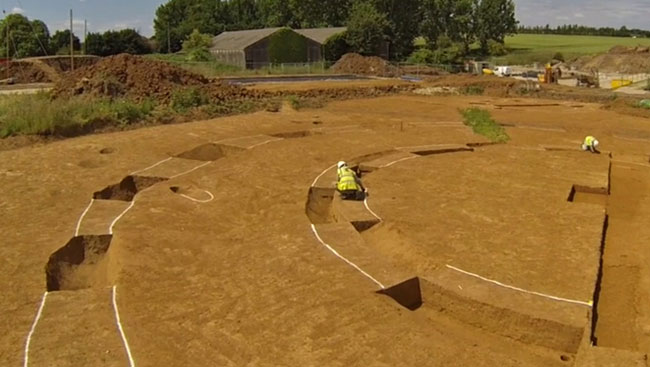
Latest Videos from Canterbury Times can be found at the following link - North Kent's answer to Stonehenge discovered by Faversham archaeologists;
http://www.canterburytimes.co.uk/North-Kent-s-answer-Stonehenge-discovered/story-22017108-detail/story.html#YH77lc2YFjVHftQb.01
The associated story can also be found here;
http://www.canterburytimes.co.uk/North-Kent-s-answer-Stonehenge-discovered/story-22017108-detail/story.html#YH77lc2YFjVHftQb.01#ixzz3AkxJZ9hr
The Swale and Thames Archaeological Survey Company (SWAT Archaeology) has discovered a Neolithic henge and archaeological remains from several periods on housing development grounds in Sittingbourne, Kent.
http://www.ibtimes.co.uk/neolithic-stonehenge-monument-burial-barrows-discovered-kent-1461201
Paul Wilkinson writes once a month on archaeological topics in the Canterbury Times- to follow the articles see the following link; http://www.canterburytimes.co.uk/Roman-Christian-religion-burial-dead-Syndale-Park/story-20772125-detail/story.html
Geophysical Survey and GPR at Teston Roman Villa on Sunday 29th June-all members welcome! Also an additional week of excavation from 18th-24th August- no cost to members
Paul Wilkinson's Articles in Canterbury Times
Paul Wilkinson writes once a month on archaeological topics in the Canterbury Times- to follow the articles see the following link; http://www.canterburytimes.co.uk/Roman-Christian-religion-burial-dead-Syndale-Park/story-20772125-detail/story.html
KAFS at the Current Archaeology Conference
We have a stand at the Current Archaeology Conference 28th Feb to 1st March at the Senate House in London-Call in to see us!
Excavation at Oplontis B (adjacent to Pompeii) in 2014 (FULLY BOOKED)
BEOWULF BBC Documentary on YouTube
A short BBC documentary shown in early 2013. It explores the theory that Beowulf could have been set in East Kent, England.A short BBC documentary shown in early 2013. It explores the theory that Beowulf could have been set in East Kent, England. Read more by clicking link below; https://www.youtube.com/watch?v=DpCPZwarDiQ
British Archaeology Magazine (November 2013) talks Roman Villas to Paul Wilkinson
"The country of Kent has a barely matched tradition of fieldwork and excavation by local groups. Here Simon Elliot, Paul Wilkinson and David Stavely describe how they came to investigate a Roman vila on the banks of the river Medway, culminating in an excavation over the 2013 Easter season..." Click on the link below to view the whole article (pdf document)
http://www.kafs.co.uk/pdf/ArchMagNov2013.pdf/
Hollingbourne Bronze Age Round Barrow Success!
Our successful investigation of a Bronze Age round barrow at Hollingbourne again has attracted the attention of the media! Click on the link below for more information
http://www.kentonline.co.uk/kent_messenger/news/bronze-age-man-talks-to-4223/
Excavation of Bronze Age barrows near Hollingbourne in Kent 21st-28th July 2013.
VIDEO NOW ONLINE TO VIEW AT YOUTUBE - CLICK HERE TO VIEW NOW
Come to the Faversham Archaeological Show in Faversham on Saturday 20th July and then dig a Bronze Age monument high on the North Downs at Hollingbourne. For details of the Saturday show see - http://www.favershaminthemaking.com/ and then for the next week dig - click here to see pdf
140 YEAR OLD OLD MYSTERY SOLVED
Excavation by the Kent Archaeological Field School over the Easter and May Bank holidays has solved an archaeological mystery that that had eluded archaeologists for the last 100 years see link below!
http://www.bbc.co.uk/news/uk-england-kent-23003797
BEOWULF Book airs on BBC1
Beowulf was aired on Monday night 18/02/13 at 7:30pm on Inside Out, BBC 1 for the South Eastwith rave reviews! Buy a copy from our ebook store or to buy the Amazon Kindle at;
http://www.amazon.co.uk/Beowulf-ebook/dp/B00BHJCD76/
KAFS and the Council for British Archaeology Annual Conference
The conference was a great event with almost 200 people attending, Thanks to the speakers and KAFS members who made it such a success
 | |
Unique 2,000-year-old Roman theatre discovered in back garden of archaeological school
Report is now online, go to 'KAFS Reports' -Blacklands. Read more by clicking link below;
http://www.dailymail.co.uk/sciencetech/article-2253091/2-000-year-old-Roman-theatre-discovered-garden-archaeological-school.html |
| 18th September 2012 - KAFS uncover Ancient Henge in North Down [KENT ONLINE]
An ancient ceremonial site the size of Stonehenge has been discovered on the North Downs. The exact purpose of the site - a neolithic “henge” near Hollingbourne - remains shrouded in mystery, but a large amount of burnt bone and pottery uncovered suggest it was used in a ritual capacity for almost 2000 years, as far back as 2500BC, the end of the Stone Age. Read more by clicking the link below...
http://www.kentonline.co.uk/kentonline/news/2012/september/8/henge.aspx
8th September 2012 - The KAFS YouTube Channel!
The Official KAFS YouTube Channel is now up and running with many videos already added. Please click the link below to see our updates and don't forget to subscribe and 'like' our videos. Please feel free to also link to us from your own account via facebook, twitter, Google or anything else! Thank you!
CLICK HERE TO VIEW THE KAFS YOUTUBE CHANNEL |
21st June 2012 - Important discoveries at Oplontis
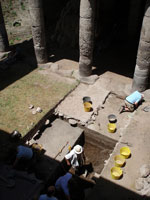
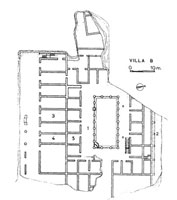
The two weeks recently spent by students of the Field School at Oplontis (below) on the so-called 'Villa B' were fantastic! The trench shown below was located across the central courtyard and the archaeology revealed ran from 79AD back to the Bronze Age. It is a rare privilege to be able to work on such great archaeology. For next year we have been invited to participate for four weeks in June working with the University of Texas on such a grand building. Places for ten people are being offered by the Field School- so if you want to excavate on one of the great Roman sites in Naples please register your interest early!
1st June 2012 - Even in Israel they found the book useful!!
For further insight to the above title - please click here to see for yourselves!
More KAFS reports are now online including virtual reality flybys of Bax Farm and Hog Brook by Bartek Cichy, although 'work in progress' they are truly stunning!
Paul Wilkinson
30th June 2011 - Highly Recommended for the Good of your Health!!
"...the committee have decided in their infinite wisdom (and quite rightly too) that it’s about time you lot found out how to conduct yourselves in the field"
If that doesn't convince you to read the rest of this blog post, then maybe you should be more cautious in your future endeavours! Follow the link below to read from the Fylde & Wyre Antiquarian;
http://wyrearchaeology.blogspot.com/2008/02/highly-recommendedfor-good-of- your.html
Don't say we didn't warn you...
28th April 2011 - KAFS Director in BBC News
KAFS Director, Dr. Paul Wilkinson enters the realm of the BBC with news on a recent excavation of a Roman settlement just off the A2 near Faversham in Kent. For more details please click the link below;
http://www.bbc.co.uk/news/uk-england-kent-13211331
|


